Report
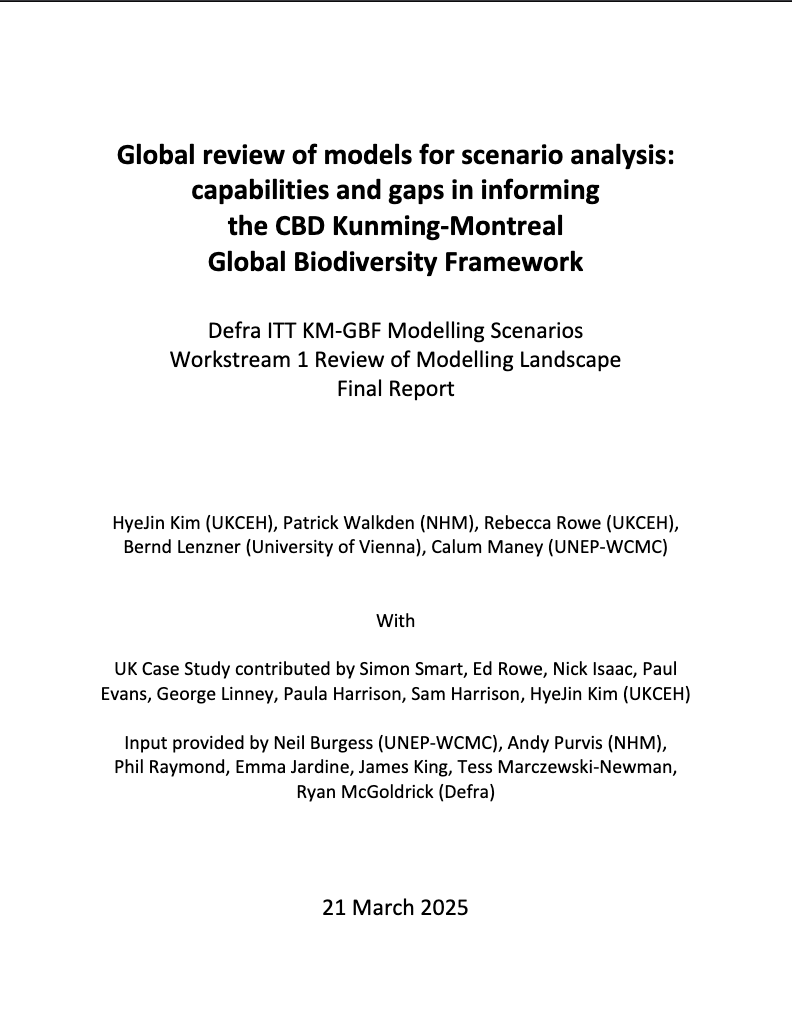
As part of the BioFutures project we assessed global scenario modelling capabilities in informing the CBD Kunming-Montreal Global Biodiversity Framework using the Nature Futures Framework.
Read the full report here
We presented key results and insights from this review at a workshop convened in May 2025, which has extended to this initiative.
Key recommendations from the report
The report suggested recommendations to support the efficacy of the implementation of the KM-GBF with enhanced use of scenarios and models for governments, modelling communities and the international policy community.
To Governments:
-
Foster Interdisciplinary Collaboration A wide range of models exist across domains that can support KM-GBF implementation. These models can also incorporate diverse values of nature in the Nature Futures Framework (NFF). Governments could promote inter- and transdisciplinary research by engaging stakeholders, model developers, and decision-makers in national planning processes for KM-GBF implementation.
-
Leverage Models for Target Setting and Spatial Planning While models and scenarios can inform KM-GBF goals and targets, they are underutilized in National Biodiversity Strategies and Action Plans (NBSAPs) and National Reports (NRs). Governments could explore how scenario- and model-based indicators can enhance target setting, spatial planning, and conservation actions. The NFF offers a creative platform to identify synergistic policies that can be taken up by diverse societal actors.
-
Enhance Data Integration and Accessibility Strengthening the integration of models, national data sources, and expertise from the modelling community will enhance the development of new scenarios and pathways. Government support in this area can improve the forecasting capability in biodiversity science, while advancing models through scientific and technological innovation.
-
Establish Repeatable Workflows for Evidence-Based Decision-Making To better inform KM-GBF goals and targets, governments could develop repeatable workflows that link monitoring to indicators using biodiversity and ecosystem service models. This approach can bridge NBSAPs and NRs, improve observation and forecasting, and enable the use of common indicators for planning, monitoring, and prioritization.
To Modelling Communities:
-
Strengthen Collaboration and Knowledge Exchange The biodiversity and ecosystem service modelling community is relatively small and fragmented, limiting its potential to inform policy and practice. Facilitating learning and collaboration across geographic regions and disciplines, particularly on the causal networks underlying the KM-GBF, is a critical step toward effective biodiversity conservation and mitigating nature-related risks.
-
Leverage Interlinkages for Collaborative Model Development The complex interconnections between models—through shared input requirements and comparable output metrics—offer opportunities for collaborative model development, complementary modelling, and model intercomparison. These efforts can enhance KM-GBF implementation. Additionally, the NFF provides a platform to co-create new societal narratives that focus on safeguarding planetary boundaries and human well-being.
-
Address Gaps in Target-Focused Indicators While many models produce indicators to inform state of nature (goals), fewer indicators address targets related to drivers, pressures, and responses. This gap can be addressed by developing indicators from the models that produce the target layer or module in the modelling framework or pipeline. Given the alignment of policy responses with target drivers, it is crucial to expand the development of target-oriented indicators.
-
Integrate Cultural and Relational Values A notable gap exists in incorporating cultural and relational values into scenario design, model development, and indicator production. This requires moving beyond technical aspects to include local and cultural perspectives of human-nature relationships. While challenging, this integration offers an opportunity for stakeholders, model developers, and decision-makers to find common ground and develop diverse and inclusive future visions.
-
Enhance Model Rigor and Standardization Existing models vary in their extent of evaluation, validation, and calibration processes. Further development in these areas is needed to reduce uncertainties and improve rigor of the model. Establishing a minimum set of variables to monitor critical aspects of nature will be key for effective biodiversity monitoring and forecasting. Modelling communities could collaborate closely with governments to standardize existing ecological monitoring programs and support evidence-based decision-making.
To International Policy Communities
-
Address Critical Gaps in Model Development Key areas such as genetic diversity (Goal A), ecological restoration (Target 2), conservation and sustainable use of wild species (Targets 4-5), and invasive alien species (Target 6) remain underrepresented in model development. Additionally, fungi, bacteria, and cultural values of nature are notably absent in current models. Addressing these gaps is essential for comprehensive biodiversity conservation.
-
Strengthen the Biodiversity Science-Policy Interface The climate science-policy interface demonstrates the power of models in informing global and national policies and related decision-making. A similar approach is urgently needed for biodiversity, given its growing importance. With the KM-GBF’s long-term goals and near-term targets agreed upon by the governments to achieve in this decade, there is a critical need to develop biodiversity-centred integrated models that represent that account for drivers, pressures, responses, and enablers outlined in the KM-GBF framework.
-
Promote Model Innovation and Intercomparison Programs Well-designed and coordinated model innovation and intercomparison programs, supported by structured science-policy connections and sustainable funding, can accelerate model development. These programs would address uncertainties in biodiversity science, the interconnectedness of KM-GBF goals and targets, and the participatory nature of the Nature Futures Framework (NFF). They would foster collaborative learning and integrated model development.